
by Rev David Cawley

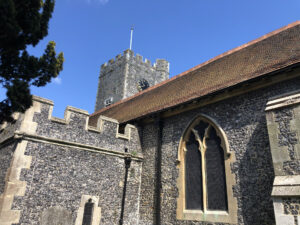
 The White Ensign flying from the summit of its 81-foot high tower shows how much this impressive building, adorning an equally impressive church, has meant over the centuries. To those who had to use landmarks to see them safely as they navigated the waters between the coast and the Goodwin sands, or who sought shelter in rough weather in Broadstairs “quaint old harbour” as Dickens called it, this great 15th-century tower, visible for miles, has been in every sense a Godsend. Long shown on Admiralty charts as a signalling station, it was in 1803 fitted up with a Telegraph during the Napoleonic scares; the remains of this were replaced by a flagpole in 1859. The White Ensign has flown ever since. The story goes that Canon Tom Pritchard (a good friend to ringers, Vicar 1954-68) received a letter from the Admiralty informing him “Having escaped so far, you may prefer to take the risk and continue what has become a tradition.” His successors have continued flying the flag. Spare a thought for the person who climbs the 99 steep steps each week to do so.


There appear to be scant records of the Bells as they were before the mid-18th century, when the Revd John Lewis in his History of the Isle of Thanet (1736) records St Peter’s as having “anciently five Bells: a few years ago these five were increased to six, the Great Bell being made two.” It is not unlikely that the old five were in weight similar to the present ring at the mother church at Minster. A similar situation prevailed at Margate (St John’s) until 1787. The resulting ring – whose founders remain unknown to us – may not have been altogether satisfactory as a decision was made in 1746 to recast the whole ring. The work was entrusted to Robert Catlin of Holborn, a prolific founder, well represented by about 50 bells in Kent including the original 5 at Lympne, Teynham (4 surviving out of 6), Faversham (4 out of 8) and St Stephen’s (4 out of the original 6-bell ring). With a tenor of 15-cwt, the St Peter’s ring was his only work in the Isle of Thanet. Catlin had inherited his foundry from Samuel Knight, and was previously his bell-hanger (Catlin’s frames include Herne and Wickhambreaux) and it is not unlikely that he provided a new frame as well as the fittings for St Peter’s new ring. Of that ring, only the 2nd (present 4th) survives to-day.
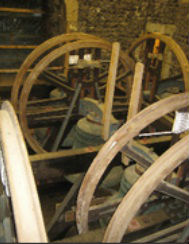
Clearly the Bells were used a great deal – whether “well used” would be appropriate is in some doubt as within thirty years two of them, the then treble (present 3rd) and 4th became cracked and in 1777 had to be recast. The founder at Holborn was now Thomas Swain, as sparsely represented in Kent as Robert Catlin was prolific, and of the four bells he cast for Kent churches, only the 3rd at St Peter’s survives. The Bells were paid for separately, the 4th in February (£22..4s..6d = £22..22½p) ) and the treble in May (£14..5s = £14.25p), so one can only guess at what happened. Sixteen years later “the third bell [present 5th] broke off in her cannons and fell down being afterwards strapped up with iron cannons” whilst the tenor, “having laid for some years useless,” was finally recast in 1800, travelling by boat to the Whitechapel Foundry of Thomas Mears, who charged for his work £32..15s..9d (£32..4p). Shortly afterwards a subscription list was opened to provide a clock, which was made by Vale in 1804.  Curiously, the Tenor was hung up above the others, so that its strike would be better heard. Then in 1822, Thomas Swain’s 4th was found to be cracked again and was recast at Whitechapel by Thomas Mear


Ringing would seem to have lapsed by the 1880’s; Stahlschmidt in his Church Bells of Kent [1887] states “Bells generally in bad order and some cracked; consequently no ringing, only chiming for services”.  At this time, the tower was itself in a very bad condition, having last been restored when the Bells were recast in 1746. The tower had been affected by settlement of the chalk foundations and by the long-standing after-effects of a 5.5 Richter scale earthquake which caused major cracking on the west and south sides: the repair work is clearly visible to-day.
At the same time, the Whitechapel Foundry, now Mears & Stainbank, reported that two more of Catlin’s Bells – the 3rd and 5th as they then were, together with the Tenor (again) were cracked and the frame and fittings required complete renewal. To celebrate Queen Victoria’s Golden Jubilee in 1887, the three cracked Bells took the well-worn path to Whitechapel to be recast, whilst the remainder were rehung in new fittings and oak frame by Samuel Snelling of Sittingbourne, the well-known and last Kent bell-hanger. The recast Tenor weighed 14cwt 3qr 9lb. A new clock, by Gillett & Co of Croydon, replaced Vale’s mechanism. The work to the tower cost £1110, the Bells £260 and the clock £157. It cost rather more in 2015/16. The new frame was made for eight, and with an eye to the future a fine set of 8 handbells was purchased for the enormous sum of £3..18s..0d [£3.90p]. The two vacant pits did not go untenanted long. In 1892 the trebles were cast at Whitechapel and hung by Samuel Snelling, and it was not long before the first peal was rung in the tower. Apart from rehanging the tenor on ball bearings – one of the first in Kent – in 1922, the Bells were to go for over 80 years without any major work being done.

By 1970, the frame was “giving notice” of its age, as also were the fittings especially the main bearings and pulleys. A visit from Whitechapel stated that the frame was rather tall and slight in its constructional details; additionally it merely sat on the bell chamber floor without being physically fastened to it. The amount of movement when the Bells were rung was considerable, whilst the “go” of the ring was less than satisfactory. Despite all this, the ringers flourished and at one time, during the period that Mrs Nellie Bridges was Captain, it boasted the largest number of learners and the largest overall band in the District. To help matters, the pulleys were renewed in 1970 which no doubt improved the “go” of the Bells.


Matters came to a head in 1975, following a KCACR report and an up-dated one from Whitechapel. Not least of their criticisms (along with the aforementioned defects in the frame and fittings) was the observation that the Bells – one each from 1746, 1777 and 1822, three from 1887 and two from 1892 had never been tuned together and the musical result was capable of improvement, the Bells being cast on a thick scale. The PCC and ringers took the brave decision to implement all the recommendations of the Bell Founders. Thus it was that in November 1975 all eight Bells took the “well-trodden path” to Whitechapel. The old fittings were removed, and during the absence of the Bells (having their canons and cast-in crown-staples removed, and being tuned and being provided with all new fittings) the frame was strengthened with a complete set of tie-rods, many of which pass through the frame heads, braces, sills, and secure the frame to the floor and beams below. On their return the Bells were rehung and rededicated by the Revd Peter Gausden (now of Monkton). Much of the tower work was done by KCACR BRF members. Apart from improved running order, the  tone of the Bells after tuning was appreciated by all – in the process some 6-cwt of metal was machined out, giving a new ‘slim – line’ ring. St Peter’s ringers under the successive captaincies of Nellie Bridges, Reg Foreman, Sonia Stockwell (all now sadly missed) and more recently Sarat White and Mary Bridges, was about to enter the “Golden Years” as the array of peal boards testifies.

To bring things up-to-date, after nearly 40 years’ constant service, the Bells were in need of a maintenance overhaul. It was at this time that major structural issues affecting the tower were identified and it was with regret that in 2015 all ringing at St Peter’s stopped for safety reasons. The ringers carried on, largely at St John’s and at St Saviour’s, Westgate; the kindness of their ringers was much appreciated. In addition, they were able to augment the Sunday service band at St John’s, and elsewhere as required for the duration. Back at St Peter’s, the ringing chamber was stripped of its ringing paraphernalia to allow the builders to undertake their work to the tower. At the same time, following visits from Whitechapel and Taylors, it was proposed not only to carry out the essential maintenance work but also to replace the unsightly rope guide (positioned too high to be of much benefit). Both foundries recommended that in view of the great height of the ringing chamber (30 feet) that two sets of guides should be fixed to steady the ropes. This design also allowed the 1970 pulleys to be done away with and correct new ones fixed so that the ropes fall in a circle rather than the two ill-spaced crescents which had served for the previous 110 years.

The two smallest bells were rehung in each other’s pit to achieve this. The foundry work was carried out with skill and devotion to detail by John Taylor & Co of Loughborough, and the KCACR “heavy brigade” again assisted with the tower work and a most generous grant of £10,000.

The restored tower was dedicated by the Bishop of Dover in January 2017  At long last St Peter’s has a ring of Bells worthy of its magnificent tower. We hope you like them. And as you leave, do admire the tower screen, designed and engraved by the late Jack Peppiatt DFC, a popular ringer in the Canterbury District, and a member here 1985-2000.

The Bells

Treble  27 1/6” diameter, weight 4-cwt 1-qr 27lb, note F, and 2nd, 27 7/8”, 4-1-12, E. 
Both inscribed MEARS & STAINBANK, WHITECHAPEL FOUNDRY, LONDON. / ALFRED WHITEHEAD, VICAR. / THOMAS BARWICK, / EDWARD S.GOODSON, CHURCHWARDENS. / 1892.                                                                 

3rd , 30½ , 5-2-18, D.  THOs SWAIN () MADE : MEE : IN J777 ()  ()  ()  [The () mark represents Thomas Swain’s unique foundry mark – the 3-bell design like Whitechapel with THos Swain Fecit below.         

4th 30 7/8”, 5-2-3, C.   ROBERT CATLIN FECIT J746 (5 ornaments)                                                                

5th, 33 ¼”, 6-1-27, Bb.  MEARS & STAINBANK, FOUNDERS, LONDON. / THIS BELL WITH THE FIFTH AND TENOR / WAS RECAST BY PUBLIC SUBSCRIPTION / IN THE JUBILEE YEAR OF THE REIGN OF QUEEN VICTORIA / 1887. 

6th, 36¾”, 8-0-22, A.  T MEARS OF LONDON FECIT. (ornament) ROBERT BARFIELD HENRY SHIVENS CHURCH WARDENS 1822.

7th, 38 3/8”, 9-2-6, G. MEARS & STAINBANK, FOUNDERS, LONDON. / GOD SAVE THE QUEEN / 1887. / ALFRED WHITEHEAD, M.A. / VICAR / THOMAS BARWICK / EDWARD S. GOODSON CHURCHWARDENS.

Tenor  43 ¾” , 13-2-22, F. [Inscription as on the Tenor].

The weight of the 1746 Tenor was given as 15-cwt; the 1800 Tenor was given as 15-0-0; and the present Tenor weighed 14-3-9 before removal of canons and tuning.  Note that the 2nd is 15 lb lighter than the Treble, and the 4th is 15 lb lighter than the 3rd.

Hall Hirers Terms and Conditions

ST. PETER IN THANET COMMUNITY HALLS HIRE TERMS AND CONDITIONS

(Reviewed May 2023)

All hall bookings are carried out via our website, www.stpeterinthanet.org.uk either by the Hirer direct or with the help of the Parish Administrator. Hirers can only use the halls during the hours agreed, and equipment, furnishings, kitchen hire must also be arranged in advance. See Kitchen Rules Appendix for full details. There is a small charge for the use of the Main Hall kitchen(see website) and this will be added for one-off bookings. Hirers must sign our on-line declaration to confirm that they have read and will abide by our Ts and Cs and GDPR protocols and the special rules relating to the kitchen, and ensuring they notify their members/volunteers/guests of these Terms and Conditions, including the fees and charges for any loss/damage/Rubbish left/ breakages/ however caused, cancellation charges, lost keys, deposits etc in our terms, and conditions.

Our bookings are subject to approval by the halls committee.

Hirers are responsible for setting up and clearing their furniture within the hired times agreed and ensure that any furniture/equipment used is replaced in the correct places and is clean.

  • Security bars must be removed from Fire Exit before the meeting/event starts.
  • In the Main Hall, hirers can find extra chairs behind the screens at the back of the stage. We ask that furniture is not dragged across the floor. 
  • We advise that tables are lifted into position using two people. 
  • The use of chalk/powder on the floor is strictly forbidden. 
  • Hirers should mop up any form of liquid immediately and display the wet floor sign. * The Halls have brooms/mops/dustpans/brushes available for use.
  • If necessary, Hirers should sweep the floor and clean the tables.
  • Please do not move furniture from the entrance foyer.

When leaving the building, the Hirer has a responsibility to ensure:

  • All lighting, ventilation, and kitchen equipment is switched off and left safe; turn off water taps in the kitchen/toilets. Turn down radiator settings to original setting if they have been adjusted.
  • Security bars to be replaced across the emergency exits.
  • All external doors are locked, including windows and fire-doors, and check that no one is left in the building including toilet areas. N.B. In the main hall, if the office is open during weekday mornings, locking up instructions should be queried with the Parish Administrator

Care

The Hirer shall undertake to take reasonable care when hiring our halls, especially regarding fixtures and fittings, the floors, tables and chairs, etc. No fixings shall be driven into any part of the buildings, if decorations are used, please do not use tape. We reserve the right to recover the cost of any loss, damages, breakages and repairs, or non-compliance of our terms and conditions from the Hirer and invoice the Hirer and expect payment within seven days. 

All rubbish is to be removed from the premises.

Please keep main doors closed, and locked where possible.

Disco Equipment/Music

  • The use of disco equipment for private functions is strictly restricted to between 9am and 10.30pm and is only allowed in the Main Hall
  • We ask that the use of such equipment be kept to as low a volume as possible to avoid a noise nuisance to our neighbouring residences.
  • At 10.30 pm all music should cease or if an extension has been granted kept at a minimum level as it should be a quiet/clearing up time.
  • At the end of hire, all individuals should be asked to leave the building quietly to save disturbing the residents. 

Bouncy Castles

  • If a Bouncy Castle is being booked for a children’s party, a small surcharge will be applied(see website). It can only be used in the Main Hall and must only be assembled at the Non-Stage end of the hall because of the ceiling-mounted projector at the stage-end. It must also be erected, dismantled and removed within the hired period by the supplier. The hirer is responsible for any damage caused by its use.

Prohibited Items

  • No Candles, Naked Lights, Sparklers, Fireworks, Oil Burners, Gas or Liquid Petroleum Flames smoke
  • No bubble machines/ foam machines, or glitter are allowed.
  • Deep Fat Frying is not allowed.
  • No attachments to light fittings shall be permitted, and no excessive load shall be placed on the Hall electrical supply system with regard to amplification, etc. Electrical appliances owned and used in our halls by hirers must have a valid PAT test label attached. 

Health and Safety

It is the responsibility of the Hirer to ensure the health and safety of all persons attending the function of which he/she is the organiser. 

  • The Hirer should familiarise themselves with the location and operation of the emergency exits and Assembly Point (Co-op Car Park). 
  • Please ensure all fire exits and emergency evacuation routes are always kept clear.
  • A first aid kit is kept in the kitchen with the accident book. 
  • If an accident occurs, report to Parish Administrator using accident report book. Located in the visitors sign-in folder and in First aid box.
  • A Defibrillator is situated by the internal door into the Main Hall. In the Foyer of The Portland Centre there is an access key to the Main Hall
  • If someone is taken ill while in the halls, they should immediately be removed from the room, and arrangements must be made to get them home, to a doctor or hospital as soon as possible. Dial 111 or 999 if an emergency.
  • Hirers are encouraged to keep a list of attendees together with a contact number and retain this for 3 weeks

Insurance

The Hirer shall NOT be covered by Owner’s insurance for any claim whatsoever arising from the activities of The   Hirer. The Hirer shall indemnify the Owner against any claim which may arise out of the hiring or which may be made by any person affected by the activities of The Hirer or person(s) visiting or using the premises during the occupation by The Hirer. The Hirer shall be responsible for taking out insurance to cover any public liability arising from their activities. The Owner shall not be liable for any loss or damage arising out of the hiring, nor for any loss, damage or injury which may be incurred or suffered by, or be done, or happen to, any person(s) visiting or using the premises, during the occupation by The Hirer, arising from any cause whatsoever, so far as any exclusion is permissible by law. The Owner shall not be responsible for any loss due to a breakdown of equipment, failure of the electricity supply, leakage of water, fire or any other circumstance which may cause the premises to be closed or the hire arrangements interrupted or cancelled. 

Indemnity to Hirer

We will indemnify You and, at Your request, any person who hires, rents or borrows The Premises for occasional social events. The maximum We will pay inclusive of Costs and Expenses is £2,000,000.

We will not provide indemnity

(1) In respect of

(a) any commercial or business hire

(b) any individual, club, organisation, society or group who hire The Premises on a regular weekly or monthly basis

(2) where indemnity is provided by another insurance policy.

Bookings: It is not our policy to hire out our buildings for individual party-political meetings or religious uses other than those acceptable to the Christian Faith. 

Performing Rights Society licences: Our premises licences are displayed in the halls’ entrances.

Sale Of Alcohol – No alcoholic drink may be sold at any time unless the Hirer has obtained a Temporary Events Notice from Thanet District Council and has produced the licence to the Halls’ Administrator or authorised representative. No licence will be authorised for Sunday use. 

Smoking/ Vaping Policy – Smoking or vaping is prohibited anywhere within our buildings.

Sub-Letting/Hall Hire – Hirers must not sub-let any room/hall, nor use any room/hall other than that set-out and paid for under their Booking Request/Invoice. 

Church function – Very occasionally a church function may have to take preference over a hirer’s regular booking.  The Administrator will give the Hirer as much notice as possible, and any hire charges will be reimbursed.

Under stage/Storage –No one is permitted under the stage unless requiring access to their storage lockers. Due to health and safety regulations, children are strictly prohibited from under the stage area (this includes the uniformed groups). 

  • We offer storage cupboards for hire by the year, but these are limited and always in high demand. 
  • If you do not have a cupboard, all equipment/items must be removed before leaving the premises. Any property left without permission will be disposed of. 
  • Ensure when visiting Cupboard/Storage area, that you sign in and out.

Lost property can be found in the cloakroom near the parish office. Unclaimed items will be disposed of after eight weeks.

Vulnerable Adults – Care of Children 

Particular attention must be given to the protection of vulnerable adults and children in line with the Safeguarding Vulnerable Groups Act 2006.

Regular Hirer

It is the responsibility of the hirer to produce a Risk Assessment for their event and to take responsibility for the safety of those attending their group.

  • It is of paramount importance that all Regular recurring Hirers are aware that it is their responsibility

to submit their own online booking requests for any future dates and that these are entered on an ongoing basis. It is suggested that as one month is paid for, the corresponding dates for the following year should be added. This will avoid hirer’s regular slots being booked online by others.

One-off Hirers

  • A non-returnable deposit of £25 must be paid at the time of booking.
  • An extra £50 returnable key deposit is required for any evening booking which extends beyond 6pm and we reserve the right to retain some or all of this if there is any mess or damage incurred.
  • Hire prices will be reviewed annually and introduced from January 1st.
  • All Hire payments must be paid in full at least 14 days before the event, by BACS. Cash or Card can be used for payment in the Parish Office.
  • The Terms and Conditions are reviewed annually by the Halls’ Management Committee and can be changed without notice. Please view them online if you are in doubt at www.stpeterinthanet.org.uk/halls/Tsand&Cs

DATED: May 31st 2023

Privacy Policy

GENERAL PRIVACY NOTICE

The Parochial Church of St Peter-in-Thanet

Website Cookie Policy

We use cookies to give you a better online experience. In order to make full use of the St Peter’s Parish website (‘Website’), your computer, tablet or mobile phone will need to accept cookies. We feel that it is important that you know what cookies our Website uses and for what purposes. This will help to protect your privacy, while at the same time providing you with the best online experience.

By clicking ‘Yes’ on the cookie banner, you give your consent to the Parochial Church of St Peter-in-Thanet to place and/or read cookies from the Website you are visiting. Some of these are session cookies which are temporary and allow us to link your actions during a browser session. Session cookies are erased when you close the browser. Other cookies are persistent cookies which remain on your device for the period of time specified in the cookie. The Website uses cookies for the following purposes:

  • FUNCTIONAL COOKIES Functional cookies are essential and help you navigate the Website. They enhance the user friendliness of the Website for visitors. These cookies make sure that your acceptance of this policy only needs to made once, and that your hall booking data is available in your Client Dashboard if you are a signed in user. These cookies also help to support website security and basic functionality.
  • ANALYTICS COOKIES Analytics cookies help us to understand the behaviour of our visitors and the usage of the Website in an aggregated manner. For instance, we can use these cookies to gain insight into how our visitors use our Website. This means we can find out what works and what doesn’t, it allows us to continuously improve the Website, and measure how effective our advertising and communication is.

We do not store any of your personal data in cookies and, unless you submit a contact request through this website, no personal data is harvested or stored from your computer/device other than the IP address from where you are accessing the site.

Your personal data – what is it?

“Personal data” is any information about a living individual which allows them to be identified from that data (for example a name, photographs, videos, email address, or address).  Identification can be by the information alone or in conjunction with any other information.  The processing of personal data is governed by [the Data Protection Bill/Act 2017 the General Data Protection Regulation 2016/679 (the “GDPR” and other legislation relating to personal data and rights such as the Human Rights Act 1998].

Who are we?

This Privacy Notice is provided to you by the Parochial Church Council (PCC) of St Peter-in-Thanet which is the data controller for your data.
The Church of England is made up of a number of different organisations and office-holders who work together to deliver the Church’s mission in each community.  The PCC works together with:

  • the incumbent of the parish (that is, our vicar or rector);
  • the bishops of the Diocese of Canterbury; and
  • the Diocesan Offices (including the offices of the Archdeacons), which are responsible for the financial and administrative arrangements for the Diocese of Canterbury.

As the Church is made up of all of these persons and organisations working together, we may need to share personal data we hold with them so that they can carry out their responsibilities to the Church and our community. The organisations referred to above are joint data controllers. This means we are all responsible to you for how we process your data.


Each of data controller has their own tasks within the Church and a description of what data is processed and for what purpose is set out in this Privacy Notice. This Privacy Notice is given to you by the PCC on our own behalf and on behalf of each of these data controllers. In the rest of this Privacy Notice, we use the word “we” to refer to each data controller, as appropriate.

What data do the data controllers listed above process?

They will process some or all of the following types of data, where necessary to perform their tasks:

  • Names, titles, and aliases, photographs;
  • Contact details such as telephone numbers, addresses, and email addresses;
  • Where they are relevant to our mission, or where you provide them to us, we may process demographic information such as gender, age, date of birth, marital status, nationality, education/work histories, academic/professional qualifications, hobbies, family composition, and dependants;
  • Where you make donations or pay for activities such as use of a church hall, financial identifiers such as bank account numbers, payment card numbers, payment/transaction identifiers, policy numbers, and claim numbers;
  • The data we process is likely to constitute sensitive personal data because, as a church, the fact that we process your data at all may be suggestive of your religious beliefs.  Where you provide this information, we may also process other categories of sensitive personal data: racial or ethnic origin, sex life, mental and physical health, details of injuries, medication/treatment received, political beliefs, labour union affiliation, genetic data, biometric data, data concerning sexual orientation and criminal records, fines and other similar judicial records.

How do we process your personal data?

The data controllers will comply with their legal obligations to: keep personal data up to date; to store and destroy it securely; to not collect or retain excessive amounts of data; to keep personal data secure, and to protect personal data from loss, misuse, unauthorised access and disclosure and to ensure that appropriate technical measures are in place to protect personal data.


We use your personal data for some or all of the following purposes:

  • To enable us to meet all legal and statutory obligations (which include maintaining and publishing our electoral roll in accordance with the Church Representation Rules);
  • To carry out comprehensive safeguarding procedures (including due diligence and complaints handling) in accordance with best safeguarding practice from time to time with the aim of ensuring that all children and adults-at-risk are provided with safe environments;
  • To minister to you and provide you with pastoral and spiritual care (such as visiting you when you are ill or bereaved) and to organise and perform ecclesiastical services for you, such as baptisms, confirmations, weddings and funerals;
  • To deliver the Church’s mission to our community, and to carry out any other voluntary or charitable activities for the benefit of the public as provided for in the constitution and statutory framework of each data controller;
  • To administer the parish, deanery, archdeaconry and diocesan membership records;
  • To fundraise and promote the interests of the Church and charity;
  • To maintain our own accounts and records;
  • To process a donation that you have made (including Gift Aid information);
  • To seek your views or comments;
  • To notify you of changes to our services, events and role holders;
  • To send you communications which you have requested and that may be of interest to you.  These may include information about campaigns, appeals, other fundraising activities;
  • To process a grant or application for a role;
  • To enable us to provide a voluntary service for the benefit of the public in a particular geographical area as specified in our constitution;
  • Our processing also includes the use of CCTV systems for the prevention and prosecution of crime.

What is the legal basis for processing your personal data?


Most of our data is processed because it is necessary for our legitimate interests, or the legitimate interests of a third party (such as another organisation in the Church of England).  An example of this would be our safeguarding work to protect children and adults at risk.  We will always take into account your interests, rights and freedoms.
Some of our processing is necessary for compliance with a legal obligation. For example, we are required by the Church Representation Rules to administer and publish the electoral roll, and under Canon Law to announce forthcoming weddings by means of the publication of banns.
We may also process data if it is necessary for the performance of a contract with you, or to take steps to enter into a contract. An example of this would be processing your data in connection with the hire of church facilities.
Religious organisations are also permitted to process information about your religious beliefs to administer membership or contact details.
Where your information is used other than in accordance with one of these legal bases, we will first obtain your consent to that use.

Sharing your personal data


Your personal data will be treated as strictly confidential. It will only be shared with third parties where it is necessary for the performance of our tasks or where you first give us your prior consent. It is likely that we will need to share your data with some or all of the following (but only where necessary):

  • The appropriate bodies of the Church of England including the other data controllers;
  • Our agents, servants and contractors. For example, we may ask a commercial provider to send out newsletters on our behalf, or to maintain our database software;
  • Other clergy or lay persons nominated or licensed by the bishops of the Diocese of Canterbury to support the mission of the Church in our parish. For example, our clergy are supported by our area dean, lay chair and archdeacon, who may provide confidential mentoring and pastoral support. Assistant or temporary ministers, including curates, deacons, licensed lay ministers, commissioned lay ministers or persons with Bishop’s Permissions may participate in our mission in support of our regular clergy;
  • Other persons or organisations operating within the Diocese of Canterbury including but not limited to, where relevant, the Canterbury Diocesan Enterprises Ltd and Aquila (the Diocese of Canterbury Academies Trust).
  • On occasion, other churches with which we are carrying out joint events or activities.

How long do we keep your personal data?


We will keep some records permanently if we are legally required to do so. We may keep some other records for an extended period of time. For example, it is current best practice to keep financial records for a minimum period of 7 years to support HMRC audits. In general, we will endeavour to keep data only for as long as we need it. This means that we may delete it when it is no longer needed.

Your rights and your personal data 


When exercising any of the rights listed below, in order to process your request, we may need to verify your identity for your security. In such cases we will need you to respond with proof of your identity before you can exercise these rights.


You have the following rights with respect to your personal data:

  1. The right to access information we hold on you
    • At any point you can contact us to request the information we hold on you as well as why we have that information, who has access to the information and where we obtained the information from.  Once we have received your request we will respond within one month.
    • There are no fees or charges for the first request but additional requests for the same data may be subject to an administrative fee.
  2. The right to correct and update the information we hold on you
    • If the data we hold on you is out of date, incomplete or incorrect, you can inform us and your data will be updated.
  3. The right to have your information erased
    • If you feel that we should no longer be using your data or that we are illegally using your data, you can request that we erase the data we hold.
    • When we receive your request we will confirm whether the data has been deleted or the reason why it cannot be deleted (for example because we need it for our legitimate interests or regulatory purpose(s)).
  4. The right to object to processing of your data
    • You have the right to request that we stop processing your data. Upon receiving the request we will contact you and let you know if we are able to comply or if we have legitimate grounds to continue to process your data.  Even after you exercise your right to object, we may continue to hold your data to comply with your other rights or to bring or defend legal claims.
  5. The right to data portability
    • You have the right to request that we transfer some of your data to another controller. We will comply with your request, where it is feasible to do so, within one month of receiving your request.
  6. The right to withdraw your consent to the processing at any time for any processing of data for which consent was sought.
    • You can withdraw your consent easily by telephone, email, or by post (see Contact Details below).
  7. The right to object to the processing of personal data where applicable.
  8. The right to lodge a complaint with the Information Commissioner’s Office.

Transfer of Data Abroad

personal data transferred to countries or territories outside the EU will only be placed on systems complying with measures giving equivalent protection of personal rights either through international agreements or contracts approved by the European Union. Our website is also accessible from overseas so on occasion some personal data (for example in a newsletter) may be accessed from overseas.

Further processing

If we wish to use your personal data for a new purpose, not covered by this Notice, then we will provide you with a new notice explaining this new use prior to commencing the processing and setting out the relevant purposes and processing conditions. Where and whenever necessary, we will seek your prior consent to the new processing.

Contact Details

Please contact us if you have any questions about this Privacy Notice or the information we hold about you or to exercise all relevant rights, queries or complaints at:

The Data Controller, St Peter-in-Thanet, The Parish Office, Hopeville Avenue, St Peter’s, Broadstairs CT10 2TR

Tel: 01843 866061

Email: DataProtection@stpeterinthanet.org.uk

You can contact the Information Commissioners Office on 0303 123 1113, or via email (https://ico.org.uk/global/contact-s/email) or at the Information Commissioner’s Office, Wycliffe House, Water Lane, Wilmslow, Cheshire SK9 5AF.

This website uses cookies to ensure you get the best experience.